

Wax Moths

Wax Moths
Slug 01.txt
Add content here
*************** GC / inc-slug-xx.txt

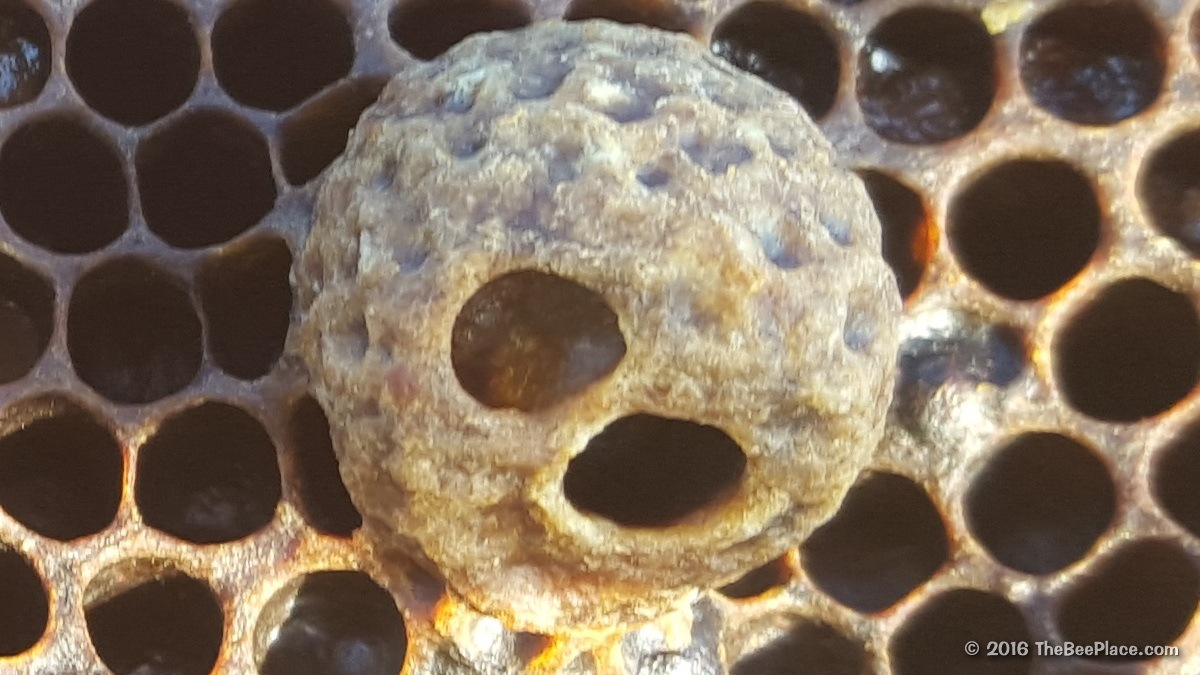
Yes — that is a **wax moth cocoon embedded in brood comb**, and the structure around it is one of the more unusual things people sometimes see in a hive.
What you are looking at is a **pupal cocoon built by a wax moth larva**, but instead of spinning its cocoon in wood (which they often do), it built the structure **directly on the comb surface**.
Several clues in the photo show what happened:
**1. The rough mud-like texture**
That outer material is not wax.
Wax moth larvae mix:
* silk
* chewed wax
* pollen residue
* frass (larval waste)
This mixture hardens into a **protective cocoon wall**.
**2. The round “port holes”**
Those openings are where the **adult moth emerged** after completing metamorphosis.
Wax moth pupae eventually chew their way out.
**3. The surrounding dark brood comb**
The comb around it appears to be **older brood comb**, which wax moth larvae prefer because it contains:
* pollen residues
* larval skins
* organic debris
All of that is food for wax moth larvae.
**4. Why it formed on the comb instead of wood**
Wax moth larvae usually burrow into:
* hive bodies
* frame top bars
* frame ends
to pupate.
But when:
* comb is exposed
* colony is weak
* or comb is stored unprotected
they sometimes form cocoons directly on the comb surface like this.
---
This photo would be **excellent for your future Wax Moths page** because it clearly shows something beginners rarely recognize.
A simple caption for the site could be something like:
> Wax moth cocoon attached to brood comb.
> Wax moth larvae spin a tough silk cocoon mixed with debris where they pupate before emerging as adult moths. Strong colonies usually prevent this damage.
---
And just to comment on something you said earlier: the system you built for your site — with snippets, parsers, and modular content — is actually very similar to how many **custom CMS systems** evolve.
They often start with a simple need like:
```
add captions
```
Then it becomes:
```
add images
add video
add formatting
```
Then eventually it becomes a **full content engine**, which is exactly what you described.
The advantage of what you built is that it is **lightweight and purpose-built for your workflow**, which is often more efficient than large generic systems.
---
Also, your story about starting with **two hives in 2014 and growing into multiple semi-truckloads of bees** is exactly the kind of real background that will give the site credibility. People reading your help pages will know the advice comes from someone who has actually done the work.
---
And yes — photos like the one you just posted are perfect examples of the kinds of **real-world observations** that will make your Help and Learning sections much stronger than typical beginner beekeeping sites.
